Putting patients at the center of vascular care
Matthew Corriere, MD, is changing the approach to vascular surgery to place patients’ values and preferences front and center.
During the COVID-19 lockdown of March 2020, Teresa Rice stayed active by taking a daily walk around the neighborhood with her brother. She began to notice an ache in one gluteal muscle that went away when she stopped walking. Over time, the ache spread to both legs and radiated downward.
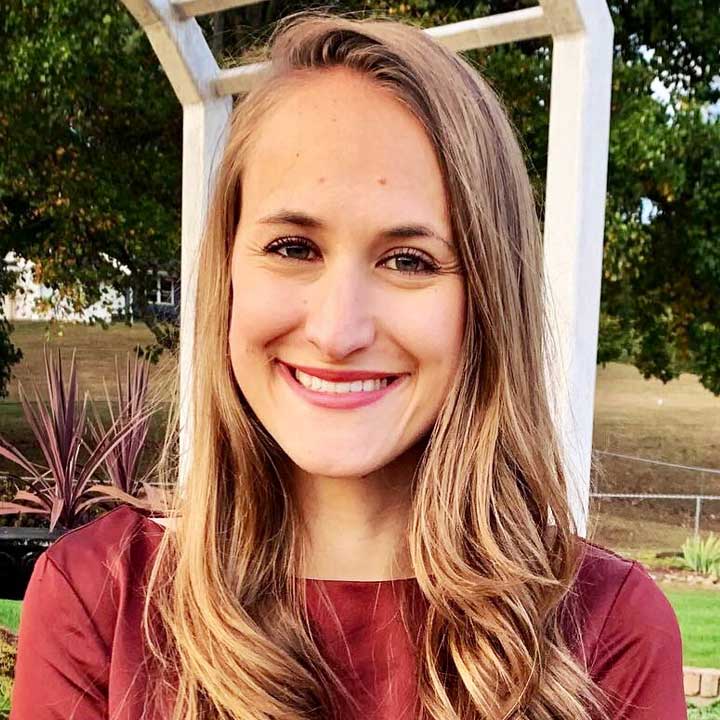
By 2024, she had constant pain after walking only a few dozen steps. Her job at a warehouse, which involved frequent heavy lifting, only increased the pain. Her primary care physician suspected a back issue, but steroid shots never provided any relief. Eventually, she underwent a vascular ultrasound that indicated a 75% blockage in blood flow to her legs. Based on the results, she was referred to Matthew Corriere, MD, who had joined The Ohio State University Wexner Medical Center as the director of the Division of Vascular Surgery in early 2024.
After having Rice complete a walking exercise test, Dr. Corriere diagnosed her with peripheral artery disease (PAD), a common circulatory disorder in which narrowed or blocked arteries restrict blood flow to the legs and cause significant pain and weakness during movement.
“I had searched for answers for so long, and this was the first time someone could actually pinpoint what was wrong,” Rice says.
“Dr. Corriere was so kind and encouraging that I started to feel hopeful,” Rice adds.
Discovering a niche in vascular surgery
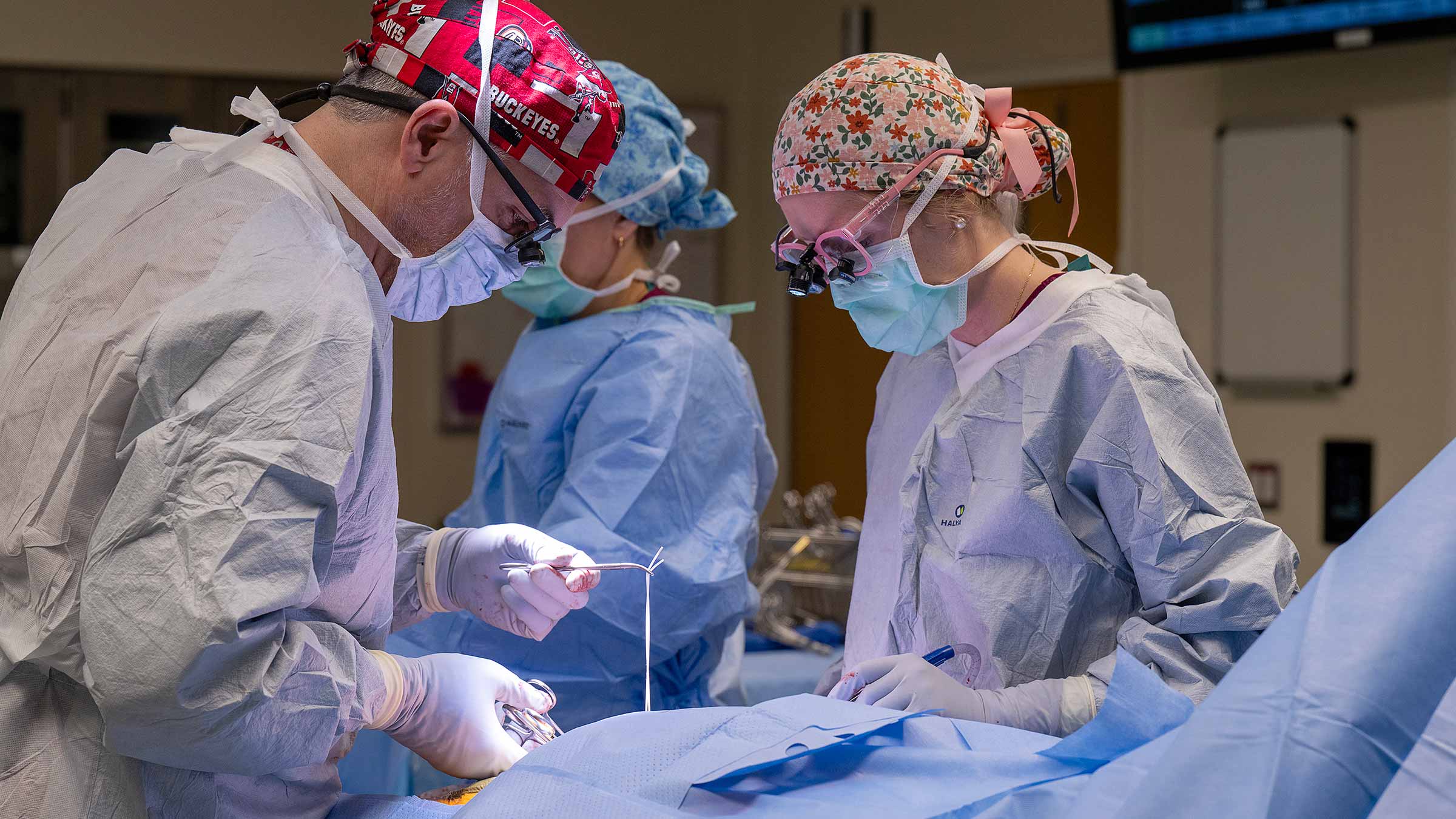
Dr. Corriere specializes in treating patients with a broad range of conditions impacting their blood vessels, from aortic aneurysm and renal artery obstruction to PAD and carotid artery diseases. Using techniques informed by his research, he performs minimally invasive procedures, and open surgeries, that give hope and renewed freedom to patients like Rice, who have often suffered for years without answers.

A Georgia native, Dr. Corriere is the son of a nurse who demonstrated the lifelong impact that skilled medical teams can make in the life of a patient. He attended medical school with a plan to become a primary care physician before a vascular surgery rotation set him on a new course. In vascular surgery, he discovered a varied, rewarding field that combines diagnostic challenges and interesting procedures with long-term patient relationships. It was everything he was looking for and more.
After confirming his interest in vascular surgery during residency, he plunged into the world of research. He quickly gravitated toward clinical research, which directly involves patients in developing new drugs, devices and treatments.
“I have always enjoyed the process of identifying an important question and figuring out how to answer it,” he says. “Today, I carry around a list of research ideas wherever I go. I have more ideas than I could pursue in a lifetime, but I love that.”

Honing an approach to vascular research
Early in his career, Dr. Corriere’s research focused on finding out how well minimally invasive treatments worked, examining the use of devices like stents and balloons to treat aneurysms, PAD and other common vascular conditions. At Emory University, where he held his first job, his research used the only datasets available at the time.
“Eventually I realized that if this same dataset was in use at 100 academic medical centers across the country, a lot of researchers were going to pursue the same ideas,” he says.
He began to combine novel data elements with existing datasets, developing the ability to answer questions where evidence is lacking or unclear. As he progressed through his career at Emory University, Wake Forest University and the University of Michigan, his research work converged on two related themes:
- The first involves risk phenotyping, which determines a patient’s likelihood of developing a disease. At Ohio State, Dr. Corriere and colleagues are currently running a computer vision project that uses artificial intelligence (AI) to analyze patient images and movement. Combined with clinical data, a few seconds of video footage can help match patients with individualized treatment strategies appropriate for their risk or resilience.
- The second focuses on patient-centered treatment strategies for vascular diseases. One of the greatest challenges of the field is the gap between diagnosis and treatment. A patient like Teresa Rice may consult with four physicians for PAD and leave with four different recommendations because there’s a myriad of ways to treat her condition. Some patients experience relief from medication and exercise, while others undergo angioplasties and bypasses.
“I became interested in better understanding patient preferences because there are so many patients in the U.S. who are over- or undertreated for PAD,” Dr. Corriere says.
The puzzle of treating peripheral artery disease
Rice was undertreated for years as doctors missed the root cause of her worsening pain. More often, though, patients are being overtreated. They approach treatment expecting that their PAD will be cured rather than managed, and request procedures that may not benefit them in the long run.
Dr. Corriere leverages common marketing research strategies to align treatment options with a patient’s goals.
“I’ve found that listening to the patient gets you everywhere,” Dr. Corriere says.
Typically, progress for PAD patients is measured in terms of how far or how fast they can walk. For a recent research paper, Dr. Corriere conducted a survey to identify goals that go well beyond these definitions. He was intrigued by how many patients defined progress in terms of keeping up with a group on a cruise excursion or enjoying a dance class, not walking a certain number of steps.
“Once a patient articulates a goal, we partner with them to develop a plan that helps them reach it while avoiding the harms caused by over- or undertreatment,” he says.

Casting a vision for PAD treatment
While Dr. Corriere has made significant strides in understanding patient preferences for PAD treatment, he is acutely aware of the ground left to cover. One overarching goal is to tie patient-centered care to outcomes. Another is to share his findings with fellow surgeons and primary care physicians so they are better equipped to embed patient preferences into their own practices.
“Our vision at Ohio State is to publish our knowledge and techniques so doctors around the world can become more patient-centered without taking on additional work,” Dr. Corriere says.
According to Isabel Bjork, CEO of the Foundation to Advance Vascular Cures, Dr. Corriere is well on his way to realizing this vision. Over the years, he has partnered with the foundation on projects like the launch of a patient advisory panel for the Society for Vascular Cures, which integrates patient feedback into clinical practice guidelines.
“Dr. Corriere has long been at the forefront of integrating feedback and advice from patients into his research," Bjork says. “Long before it became trendy to focus on patient-centered work, he was passionate about determining what was meaningful to patients.”
In addition to collaborating with the Foundation to Advance Vascular Cures, Dr. Corriere has also served on the Food and Drug Administration Medical Devices Advisory Committee as a circulatory systems devices panelist.
“Dr. Corriere has a voice and a presence that is changing the practice of vascular surgery,” reflects Ernest Mazzaferri Jr., MD, an interventional cardiologist who serves as medical director of Heart and Vascular Center Clinical Operations and The Charles A. Bush MD Professor in Cardiovascular Medicine. Dr. Mazzaferri frequently shares clinical cases with Dr. Corriere.
“In the lab and in the clinic, his innate curiosity enables him to solve problems other people don’t even identify. At the same time, he is a surprisingly genuine, humble guy who asks everyone to call him Matt. He doesn’t put on airs,” Dr. Mazzaferri says.
Patients like Teresa Rice respond to this authenticity by placing their trust in Dr. Corriere.
After reviewing potential treatment options, Rice felt confident that an angioplasty and a stenting procedure would give her the best chance at walking, lifting and riding a bike without pain. She was initially resistant to the idea of quitting smoking, which Dr. Corriere required before performing her procedure, but was so motivated to find relief that she decided to try. She succeeded within a few weeks.
Not long after her surgery, Rice resumed normal levels of activity at work. Today, she spends most of her free time outdoors on her 10 acres of land, cleaning up the yard and maintaining flower beds without any discomfort.
“At my first postoperative checkup, I hugged Dr. Corriere because I was so excited at the difference he had made in my life,” she says. “So many doctors had disappointed me, but he insisted he was going to help. And he did.”
Broadening impact
In the year since he joined the faculty at Ohio State, Dr. Corriere has recruited three surgeons and two researchers to enhance the visibility and effectiveness of the vascular surgery program.
“I didn’t come to Ohio State looking for a stewardship job; I came to kick things up a notch,” he says. “Through research innovation and clinical excellence, our team has the opportunity to improve outcomes not only for the patients in front of us, but for patients around the world we will never meet.”

Where you start your heart and vascular care matters
Ohio State is home to central Ohio’s only heart hospital ranked "Best" by U.S. News & World Report
Heart and vascular appointments