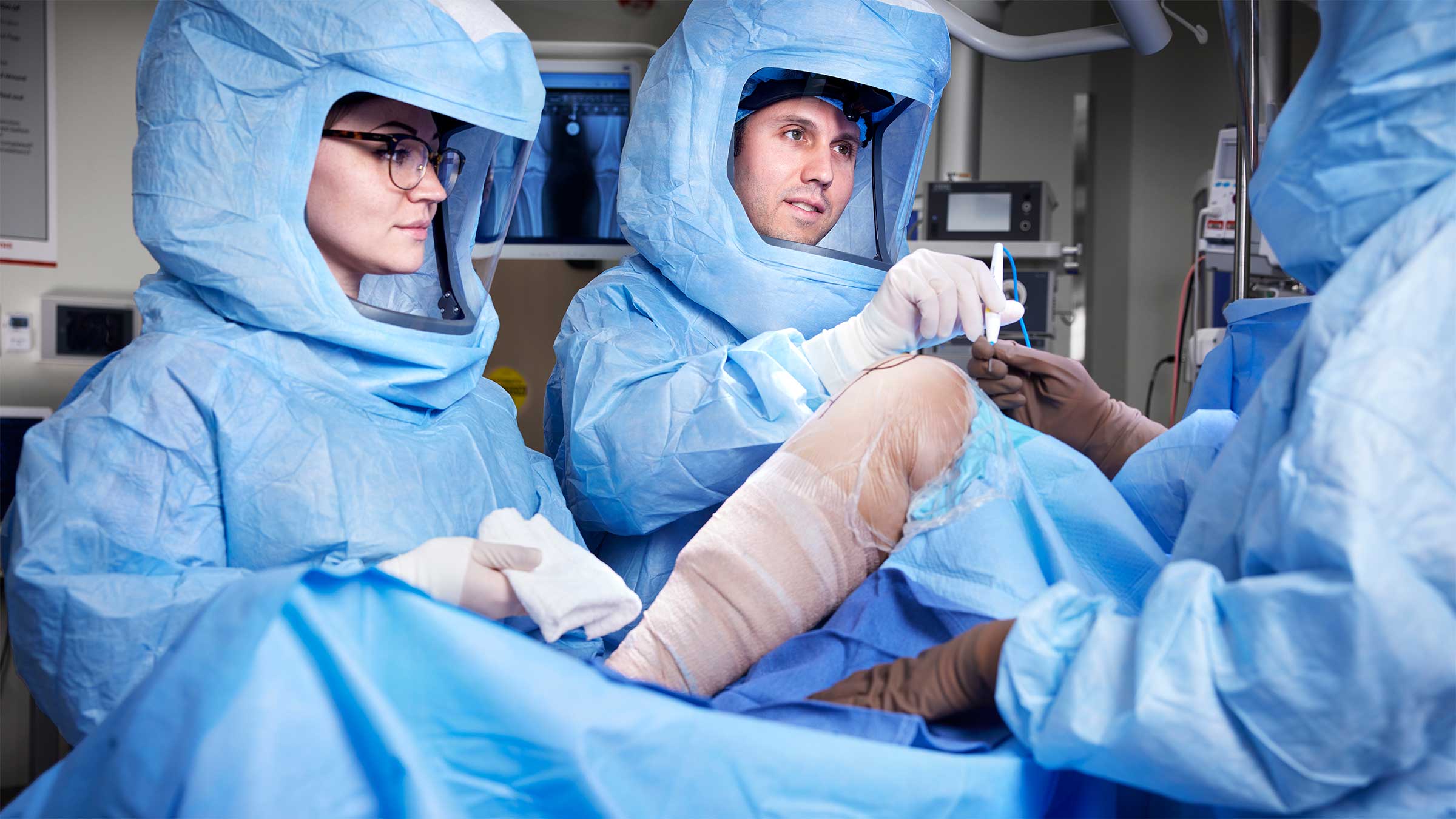
A painful knee with joint and tendon damage can limit your steps.
While a knee replacement surgery offers hope, the prospect of a long, difficult recovery can be daunting.
A quadriceps-sparing surgical technique – offered by several surgeons at The Ohio State University Wexner Medical Center orthopedics program – can cut the recovery time down by a month.
While this technique isn’t suitable for every person getting a knee replacement, many people experience less postoperative pain, quickly regain knee strength and undergo a shorter rehabilitation period when the quadriceps muscle is spared during surgery.
Quadriceps: The muscles that power your knees
Quadriceps, or quads, are a group of four muscles on the front of the thigh.
These muscles enable you to extend your knee and play a crucial role in walking, running and jumping, but they also stabilize your leg during movement.
Quads ensure seamless and strong transitions between sitting, standing and other dynamic movements.
Cutting quads: Traditional Knee Replacement
During knee replacements, surgeons install hardware to replace damaged joints and allow people to return to active lifestyles.
Traditionally, the quadriceps muscle is disrupted and partially cut during the procedure. A surgeon makes an incision through part of the quad muscles and separates the inner (medial) section of the quadriceps muscle from the central and outer (lateral) sections.
Surgeons divide the quadriceps to gain access to the knee joint. For patients, cutting muscle and tendons means a longer recovery. It takes work to rebuild.
Physical therapy typically lasts 12 to 16 weeks.
Quad-sparing surgery shields your muscles
Using the quad-sparing technique, the surgery becomes more anatomically precise, potentially leading to improved recovery outcomes – less pain, more function.
It’s technically more challenging and often requires greater expertise from the surgeon. Many surgeons, especially those treating very muscular patients, may avoid it because of its difficulty even when it’s possible to perform.
But, by working around the quadriceps and using smaller incisions, this technique minimizes trauma to the surrounding tissue. The result: preserved muscle tissue, less trauma and a faster recovery.
It also helps preserve nerve connections, allowing for a more natural-feeling knee, and it may contribute to improved long-term wear, because more natural stresses and rotation are maintained by keeping the muscle untouched.
The initial four to six weeks after surgery are more tolerable with this technique, and people are able to get back to regular movements more quickly without assistive devices, such as crutches.
Patients still undergo eight weeks of physical therapy.
Ideal candidates for sparing quadriceps
This approach is best for patients who fit specific criteria:
- Relatively good muscle strength
- Minimal deformity of the bones
- Less complex knee disease
It may not be suitable for individuals with severe joint damage, marked obesity or unusual bone structure.
It's crucial that the care team selects appropriate candidates to ensure the best possible outcomes and avoid disappointment from unrealistic expectations.
Tracking outcomes and helping younger patients with knee replacements
Ohio State is in the process of tracking outcomes to compare this technique with traditional cases. Quad-sparing knee surgery is gaining renewed attention as surgeons offering more options for eligible patients and seek improved outcomes for joint replacement.
The age of those who are getting knee replacements has lowered. About 75% or more of patients are now younger than 70, with about 25% under 50 years old. Most of this younger population falls within their 40s, although there are some patients in their 20s and 30s, particularly those with sports-related injuries like cartilage or meniscus tears.
Many middle-aged patients are lifelong athletes who had previous injuries when they were younger, such as torn ACLs. Such injuries often trigger a cascade leading to post-traumatic arthritis.

Ready to stop the pain?
Schedule an appointment with one of our orthopedic experts.
Get started