Tackling orthopedic joint infections on all fronts
Ohio State team works to reverse the life-altering limitations of infections after hip or knee joint replacements.
Brian Lewis took a deep breath and braced himself.
A sudden, intense pain surged through his leg and hip, burning like jagged metal.
“It was a miserable experience,” he recalls.
For more than three years, Lewis fought a joint infection after undergoing a hip replacement in 2017 near his home in Pennsylvania.
“I went from hiking 10 to 15 miles a day to being happy just to make it from my chair, walk down to the kitchen and back,” Lewis says.
Joint infections are typically caused by bacteria that form a slimy film on artificial joints, leading to pain, swelling, reduced movement, hard-to-treat wounds – and for about a third of infected patients, can result in death, says orthopedic surgeon Douglas Chonko, DO.
“Infections are the worst complication of a hip, knee or any replacement,” Dr. Chonko says. “Infections can require multiple surgeries and take a long time to clear.”

Searching for orthopedic infection experts
In Lewis’ case, it took more than a year for a doctor near his home to diagnose his infection.
Then, he underwent six surgeries across three different medical centers in Pennsylvania to attempt to eradicate it. Lewis developed sepsis while hospitalized – a dangerous response to infection – and nearly died.
“We had complications and just weren’t getting answers at facilities that were close to us,” says Jennie Lewis, Brian’s wife.
She frantically searched for solutions to help save her husband.
“I did some extensive research and found that Ohio State has the leading program in the country,” Jennie Lewis says.
After a near-death experience, and a growing list of doctors and surgical centers, Ohio State felt like Brian Lewis’ last hope.
The couple made a five-and-a-half-hour drive to Columbus.
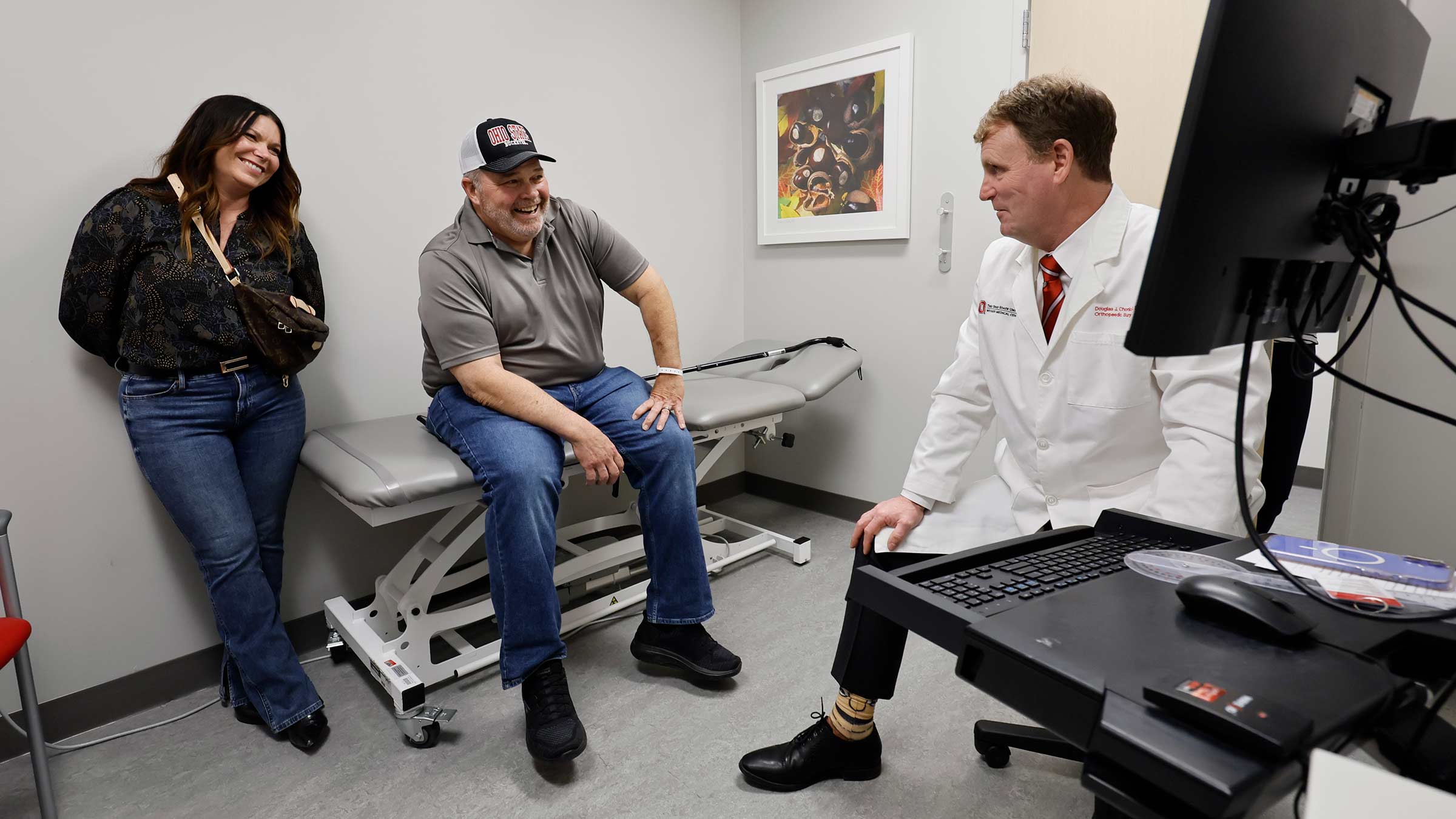
Dr. Chonko remembers meeting the Lewises.
“His pain was really significant because not only did he have an infection, his femoral stem connecting his leg to his hip socket was loose as well,” Dr. Chonko says.
Brian worried he would lose his hip to the infection.
“You lose your independence and worry about the burden you’re putting on other people,” he says.
Jennie remembers thinking, “What’s life going to look like after that?”
How knee and hip joint infections develop
About 3 million people in the United States undergo hip and knee replacements each year.
Thankfully, most never develop infections.
But for 2%, or about 100,000 patients, infections develop and can be severe and often life-altering.
Nationally, the number of infections is expected to rise as more younger people undergo hip and knee replacements compared to previous generations.
Bacteria are also presenting new challenges.
“The bacteria keep evolving to where they’re resistant to our antibiotics, and they’re better at defeating the immune system, too,” Dr. Chonko says.
Oral and intravenous (IV) antibiotics are often ineffective at joint infection sites after total hip or knee replacements because of limited blood flow around the hardware, allowing bacteria to survive, Dr. Chonko says.
“Even if only a few bacteria get on that implant, there’s nothing to stop it from growing. Antibiotics don’t get there in quantities that are adequate enough to stop the infection,” he says. “For most people, surgery is needed.”
Biofilm, a slimy substance created by bacteria, can develop in as little as 10 to 15 minutes.
About half of these infections likely begin after exposure during surgery, with another half developing from unrelated infections years later, Dr. Chonko says.
Infected cuts or even dental infections can cause bacteria to enter the bloodstream, making the prosthetic joint area a prime spot for infection to develop.
Fighting active joint infections
If joint fluid cultures identify the specific infection, antibiotics targeting that bacteria can be prescribed. Delivering antibiotics right at the site of the infection is often effective.
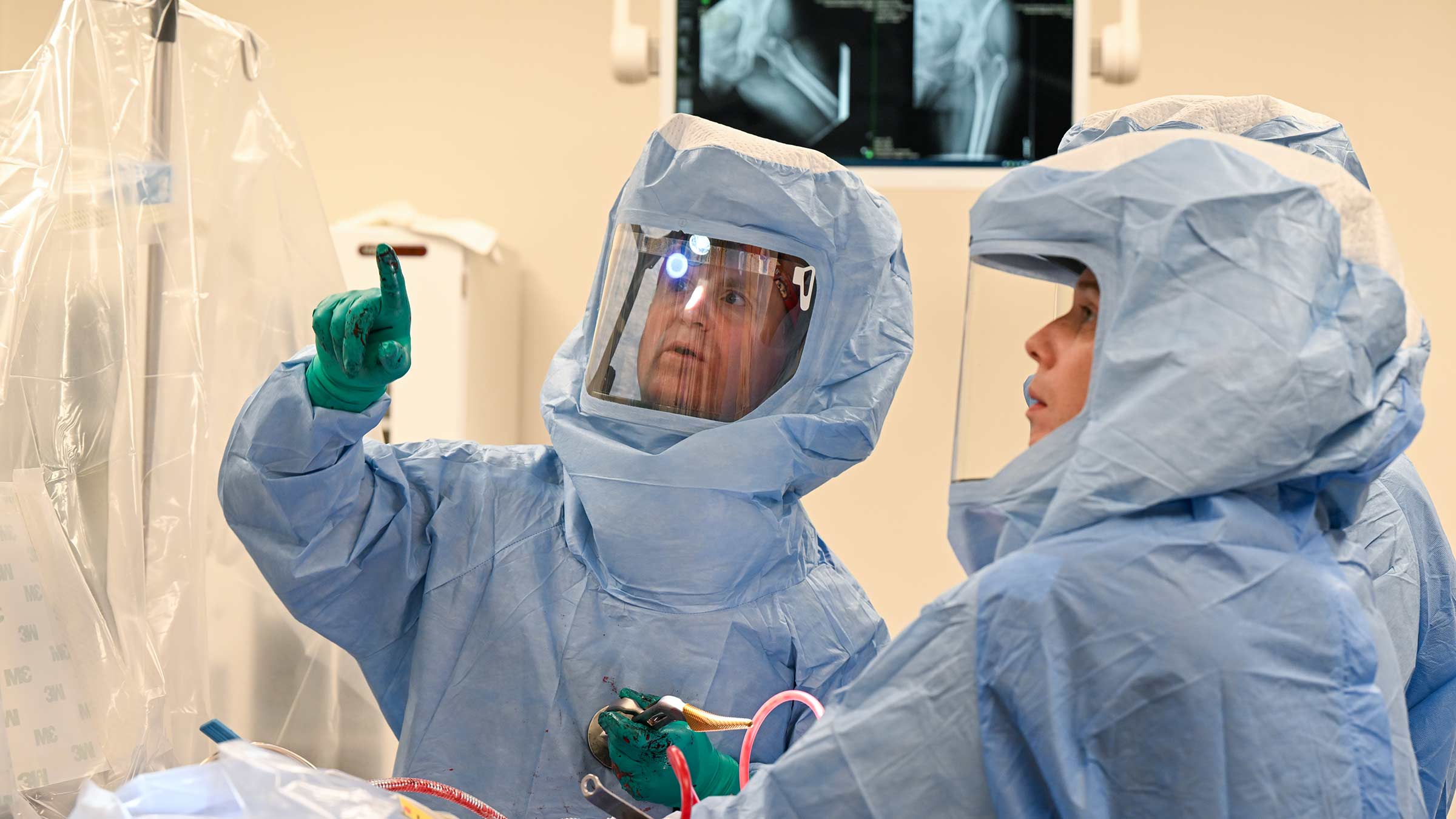
Lewis underwent surgery at Ohio State over the summer to have a medicated spacer placed in his hip where the infected hardware was removed.
An antibiotic spacer uses parts that resemble a hip replacement and is anchored with antibiotic cement. It delivers highly concentrated antibiotics directly to the infection site. Later, it can be easily removed without damaging the surrounding bone.
Dr. Chonko was optimistic about Lewis’s outcome. If the treatment worked, he could eventually give Lewis a new hip.
“One out of five patients will have that infection the rest of their lives,” Dr. Chonko says. “Sometimes we’re not successful at getting rid of it when there are multiple different bacteria that have resistant bacteria involved.”
Those with more severe infections have IVs with antibiotics daily or remain hospitalized.
“It really does alter someone’s lifestyle. When people come in, I tell them this is going to change your life for the next six months,” Dr. Chonko says.
Fortunately for Lewis, the spacer worked, and his body cleared the infection within a few months.

Creating a new model of care for joint infection patients
Six years ago, Dr. Chonko came to Ohio State to build a program to treat orthopedic infections.
“We always have someone who’s available to coordinate the care of these infections 24/7,” Dr. Chonko says, noting that’s often not the norm.
There are less than 10 dedicated joint infection programs in the country.
“Doctors call me for advice, saying, ‘Am I doing the right thing? Is this how you would treat it? Is this the right antibiotic?’” Dr. Chonko says. “When I feel like it’s out of their area of expertise or if they don’t have a needed specialty, I tell them, just send patients here. We’ll take care of them.”
Part of the program’s success stems from a team of specialists assembled for each patient.
- Plastic surgeons can assist with skin grafts and moving muscle.
- Infectious disease physicians and pharmacists work in tandem to determine the medication recommendations for each patient.
- Hospitalists are on the front lines, treating admitted patients.
Ohio State’s team sees about 400 patients from across the country each year, and it continues to expand.
Patients can enter the program through referrals, by calling to make an appointment or even by showing up at the Emergency Department, if the infection is severe. The team understands the urgency of treatment and fast-tracks appointments.

Back on his feet after periprosthetic joint infection
In August, Dr. Chonko was able to give Lewis a new hip.
At his checkup, Lewis walked freely, without his cane or assistance.
“You just have to experience Dr. Chonko. He is kind. He is compassionate. He is so well versed in his craft,” Jennie Lewis says. “This was never just about fixing a hip. The entire team understood how much an infection like this takes from a person physically, mentally and emotionally. That level of coordinated care is what saved Brian. This team makes you feel like family.”
Brian Lewis now proudly wears Ohio State hats even though he lives just south of State College, Pennsylvania.
“Thank God we got here,” he says. “Life is looking good again.”

Severe bacterial joint infections can upend your life
Ohio State’s Joint Infection Program restores mobility and hope.
Learn more