Unraveling a cancer research mystery: why normal cells transform into cancer cells
Cancer researcher Dawn Chandler, PhD, examines the inner realm of cells to understand how cancer begins.
In biological science circles, Dawn Chandler, PhD, is driven to discovery.
“I’m a very curious person who’s always been drawn to nature and learning how things work,” says Dr. Chandler, a researcher at the OSUCCC – James who probes the workings of cancer at its most basic levels.
“I considered medicine as a career, since my stepdad and his father and grandfather were physicians, but I realized that I was more of a discoverer than a clinician,” she says. “I’ve always wanted to be the first to know and understand things in the world. And a lot of times since making my career decision, I have been the first to understand a particular molecule or function, which is super exciting.”
And super important. Without understanding how and why normal cells transform into cancer cells – the essence of her laboratory team’s research – scientists and doctors wouldn’t be able to stop the process or treat each patient’s biologically unique disease.
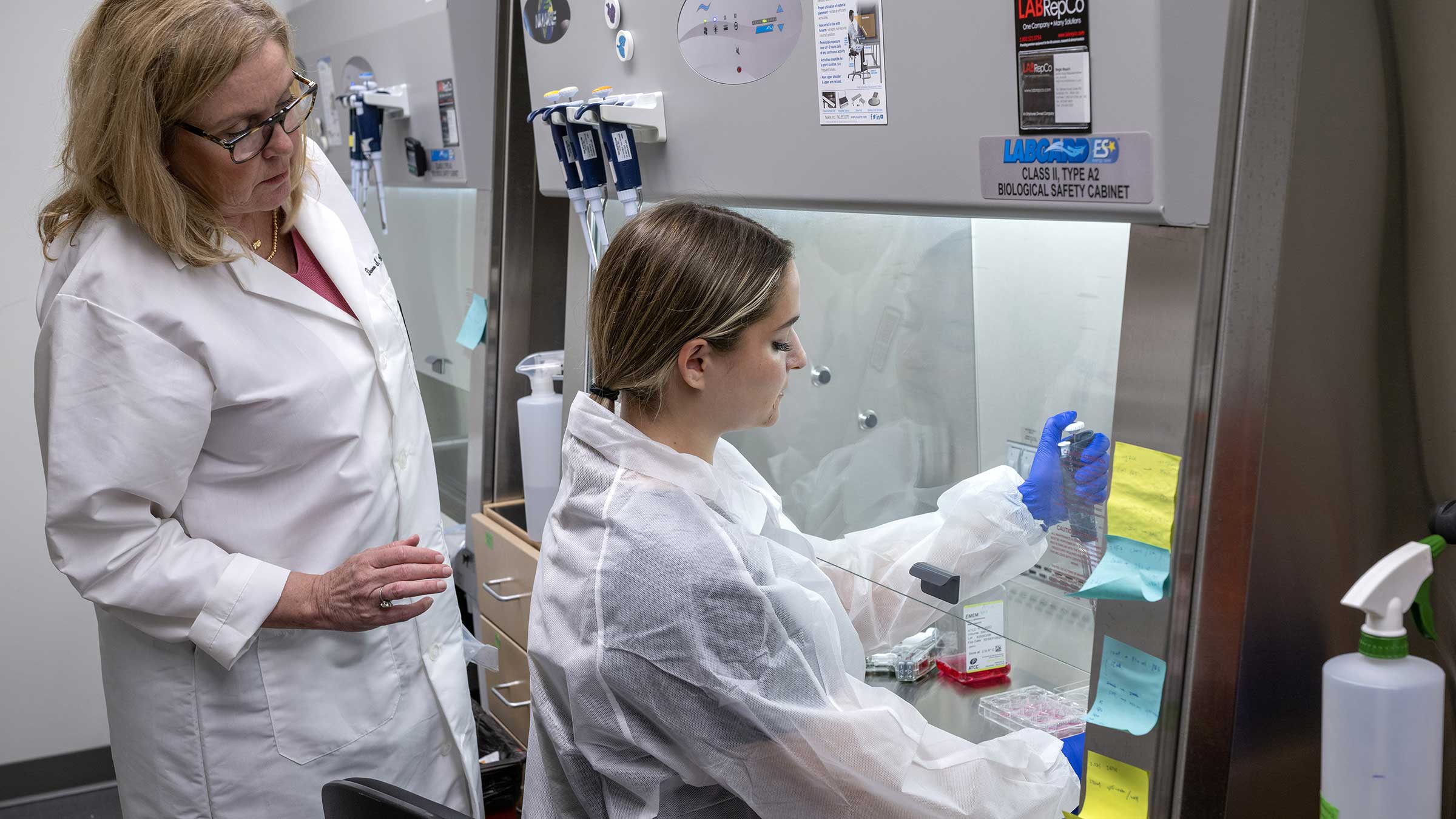
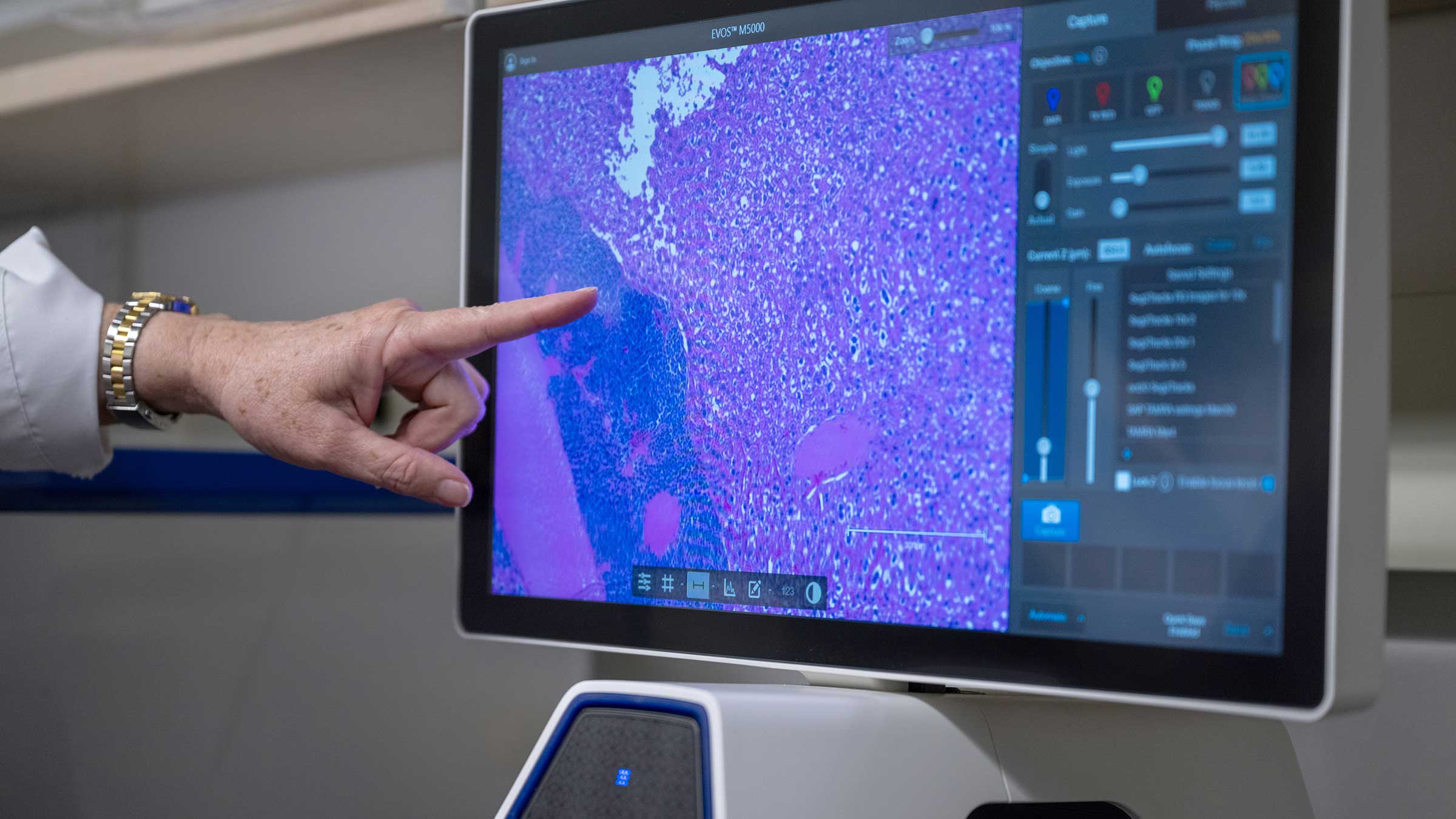
Dr. Chandler’s intense curiosity is an asset for exploring the microscopic realm inside cells, the building blocks of life that she studies in her work.
Her team focuses on how a natural cellular process called RNA splicing – in which a set of genetic instructions tells cells how to create proteins – can go wrong and lead to tumor formation by producing variant proteins in the cell.
Dr. Chandler compares RNA splicing to the words and punctuation of a sentence, where the exons (molecules that contain instructions for building proteins) can change the makeup of a cell, much like the meaning of a sentence can be changed by replacing words.
“Like the words of a sentence, the exons are already in the correct order, but the cell chooses which ones to include in the final version,” Dr. Chandler says.
“Skip a single word or punctuation mark, or include one that shouldn’t be there, and the meaning can change entirely. In cells, those changes can produce proteins that behave very differently, sometimes in ways that drive cancer,” Dr. Chandler says.
To illustrate this, she offers the sentence: “Let’s eat, Grandma.” Each word – “Let’s” “Eat” and then a comma followed by “Grandma” – represents an exon, but splicing errors can occur. For example, the comma may be omitted, changing the sentence to: “Let’s eat Grandma.”
“So instead of enjoying a picnic, Grandma is being eaten by a wolf, like in Little Red Riding Hood,” Dr. Chandler explains. “A tiny exon can play a large role in what the sentence, or the genetic coding sequence, means.”
The more her team can understand faulty RNA splicing and how it can create variant proteins that may cause cancer, the better their chances of finding corrective therapies that improve cancer care.
Savoring her shared leadership role of the OSUCCC – James Cancer Biology Program
In 2024, Dr. Chandler was appointed as one of three co-leaders of the OSUCCC – James Cancer Biology Program, whose members study cancer at its most basic level and bring their discoveries to other scientists who are testing new treatments with the aim of improving patient outcomes.
She loves working with her fellow co-leaders – Matthew Ringel, MD, The Ralph W. Kurtz Chair in Hormonology, and Gina Sizemore, PhD – whom she describes as great researchers, and she appreciates her shared leadership role and the broader research perspective it provides.
“I thought I knew a lot about the Comprehensive Cancer Center because I’ve been here a long time, but in the past two years I’ve met so many more of our scientists and have gained a better understanding of their research,” she says. “One of the advantages of being a program leader is having an opportunity to bring people with different strengths together to study important problems and questions in cancer research.”
Pelotonia plays important part in her work
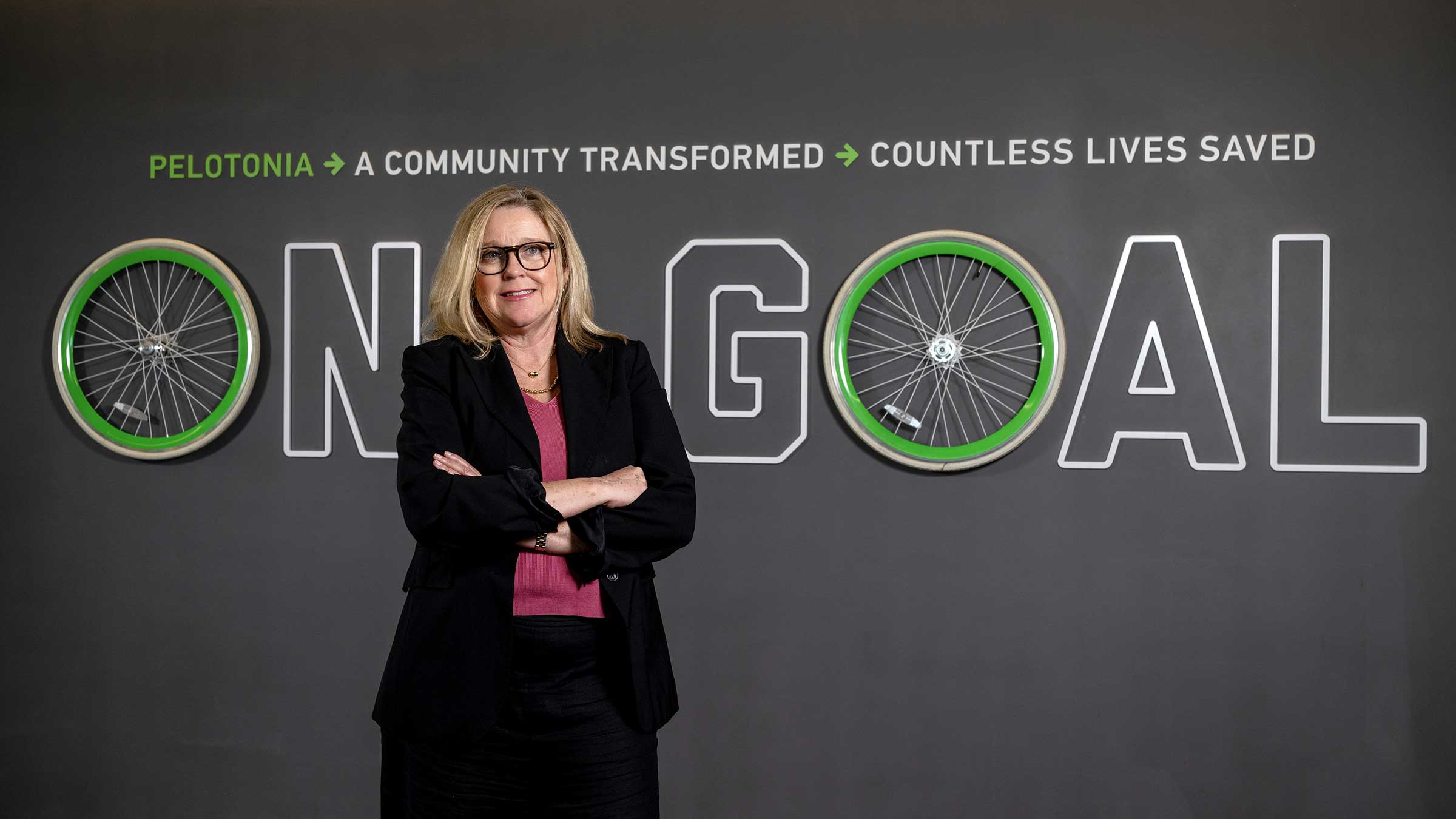
Dr. Chandler is also grateful for the support her lab has received from Pelotonia, the community annual and cycling event series that raises millions of dollars for cancer research at the OSUCCC – James.
Her lab is in the Pelotonia Research Center. In the fall of 2025, she and Philip Tsichlis, MD, received a Pelotonia-funded Idea Grant to examine the role of a gene called IWS1 in RNA splicing that helps tumors survive in low-oxygen environments, a condition called hypoxia.
The team has shown that tumors growing in hypoxia adapt by producing an alternative form of the protein produced by the KDM2B gene, and that this change is affected by the IWS1 gene. “We’re exploring the hypoxia-adaptation mechanism and designing strategies to target it therapeutically,” she says.
In addition, Dr. Chandler’s lab has benefited over the years from the work of several Pelotonia Postdoctoral Scholars, including current scholar Xia Zhou, PhD.
“Dr. Zhou is a brilliant scientist who’s doing great work. I can tell you I’m proud of all my students at all levels,” Dr. Chandler says.
Dr. Chandler was named as Pelotonia Mentor of the Year at the 2026 Pelotonia Research Symposium.
“I had no idea that was coming,” she says. “When they called my name, I had tears in my eyes because I was so surprised and honored.”
She herself is a longtime Pelotonia rider with Team Momentum, which represents the Department of Molecular Medicine and Therapeutics (MMT) as a part of Team Buckeye, Ohio State’s official Pelotonia team.
Texas-to-Ohio trek defined by determination
Dr. Chandler was born in Columbus, Ohio, but grew up in Texas. She earned a PhD at The University of Texas School of Biomedical Sciences and MD Anderson Cancer Center, where she completed her training and was an instructor before joining the Department of Pediatrics at Ohio State and Nationwide Children’s Hospital in 2005.
“I was attracted by the strong relationship between Nationwide Children’s and Ohio State, with all their great collaborations and resources,” Dr. Chandler says.
She notes that she also was influenced by the man who recruited her, the late Stephen Qualman, MD, who directed the Center for Childhood Cancer at The Research Institute at Nationwide Children’s Hospital. “He was a great person who had a very scientific mind.”
During her training at MD Anderson, Dr. Chandler studied RNA splicing in fruit flies (drosophila). She later applied those insights to human disease at Nationwide Children’s Hospital, focusing on how splicing changes drive pediatric conditions such as spinal muscular atrophy and cancer. Now, in the MMT department, her work has expanded to adult cancers, with an emphasis on developing therapies that target splicing defects.
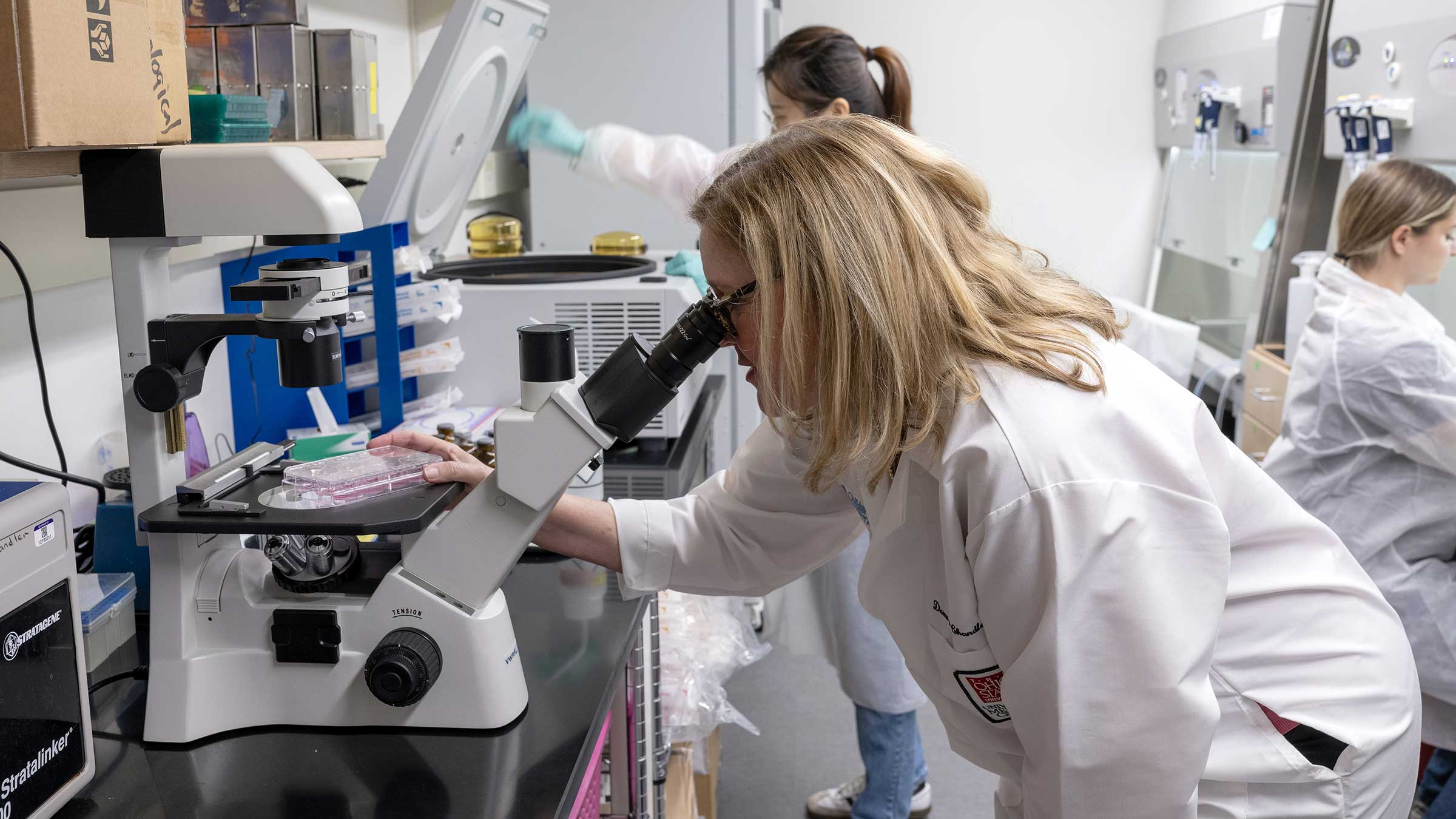
“I like to say I moved up the evolutionary ladder by about 90 million years to study splicing in human cancers,” she says. “The gene I worked on in drosophila is important for the regulation of multiple splicing events and is the target for therapies for spinal muscular atrophy, a neurogenerative disease. What we learn from small animals like drosophila is also important and applicable to therapies in humans.”
No matter which rung of the evolutionary ladder she studies, Dr. Chandler applies a dogged work ethic. “In grad school, I’d stay at work all night if I had an experiment that needed to go on. I couldn’t wait to find that next answer, that next piece of the puzzle.”
Realizing her passion in a cancer research career
But nowadays she also must balance her workload with her family, including her husband, Hadden Sayers – an award-winning blues guitarist, singer and songwriter – and children August and Autumn. While her schedule is busy, she prioritizes rest and balance to keep her mind sharp and bring her best self to both her science and her family.
“I’m driven by a passion for what I do, so much so that working hard to fight cancer hardly feels like working at all,” Dr. Chandler says.
“It’s exhilarating to make a discovery and know that it could lead to a therapy,” Dr. Chandler says.
She handles everything with humility and humor, as evidenced by a sign on her desk that reads, “Every day is the dawn of a new error.”
“When I got my first lab, my mom bought me a poster that contained my birthdate and showed how the stars looked on that day, along with the words, ‘The dawn of a new era,’” Dr. Chandler says. “She wanted me to hang it in my office, but I couldn’t because it sounded so conceited. When I found this other sign that changes ‘era’ to ‘error,’ I told her that’s more appropriate.
“It also emphasizes that research involves making mistakes and reframing,” she continues. “What we learn from our mistakes in science is important.”
Which is why she also displays in her office an Albert Einstein quote: “If we knew what we were doing, it wouldn’t be called research, would it?”
“We have to make some mistakes and ‘redo’ it so we can call it ‘research,’” she says. “That’s how discovery happens. Each step, even a misstep, brings us closer to understanding disease and finding better ways to treat it.”

Your support fuels our vision to create a cancer-free world
Your support of cancer care and pioneering research at Ohio State can make a difference in the lives of today’s patients while supporting our work to improve treatment and reduce cases tomorrow.
Ways to Give